 Tools
Tools
Tools for working with files
A navigator across converters, archivers, viewers and developer utilities: which one you need when and what is safer — online or desktop.
Every file on your computer or smartphone has a format — it is defined by the extension (.pdf, .heic, .iso, .json) and tells the system which program to use to open the file. When the right app is missing, you get the familiar error "Windows can't open this file", or Android simply ignores the attachment. This guide solves the problem: for every popular format we have gathered proven ways to open, view and convert the file — for free and without risk to your data.
Below, formats are grouped by category. Choose the one you need and jump to the detailed "how to open .X" guide.
Text documents, spreadsheets and presentations are the most common reason to consult this guide. Formats like .pdf and .docx open almost everywhere, but e-books (.fb2, .epub, .djvu) and legacy office extensions (.doc, .rtf, old .pages) often leave users stuck.
The main rule: PDF is universal and opens right in the browser, whereas editable formats are best opened with their "native" app — otherwise the layout breaks. For a one-off task an online viewer will do; for regular work, install the free LibreOffice suite.
If a file won't open, in 90% of cases the cause is a wrong extension or a corrupted download.
How to open popular document formats:
Opens right in the browser, the universal document format.
Open → .DOCXWord, LibreOffice and online editors without losing layout.
Open → .FB2E-books: apps and online readers.
Open → .EPUBThe e-book standard for all devices.
Open → .DJVUScans of books and documents: viewers and converters.
Open →Don't know a file's extension? Turn on the display of extensions in Windows Explorer — we show you how.
Ordinary .jpg and .png cause no trouble — any system opens them. Difficulties start with modern and professional formats: .heic from iPhones, .webp from the web, .raw/.cr2/.nef from DSLR cameras, and vector .svg, .eps, .ai.
HEIC is the leader in the number of questions: photos from an iPhone don't open on Windows and Android "out of the box", even though their quality is higher than JPEG at a smaller size. This is solved either by installing a codec or by converting to JPG.
How to open popular image formats:
iPhone photos on Windows and Android: codecs and conversion.
Open → .WEBPImages from the web: browsers, viewers, converters.
Open → .SVGVector graphics: browser and graphics editors.
Open → .RAWDSLR camera shots: viewing and processing.
Open → .EPSA vector format for print and design.
Open →Media files are finicky because of codecs: the extension (.mkv, .mov, .avi, .flac) is just a container, and inside there may be a codec your player doesn't understand. Hence the classic: video plays without sound, or sound without picture.
There is one universal solution — the free VLC player, which plays almost everything. The standard Windows player doesn't support many of these formats.
How to open popular media formats:
A video container: VLC and other players.
Open → .MOVApple video: players on Windows and Android.
Open → .FLACLossless audio: players that support the format.
Open → .M4AAn audio container: playback and conversion.
Open →The free VLC player plays almost all video and audio formats without installing codecs.
Archives compress and package files. Windows itself unpacks .zip, but .rar, .7z, .tar.gz require a separate program — most often the free 7-Zip. A common problem: the archive asks for a password or throws an "archive is corrupted" error — usually this is an incompletely downloaded file.
How to open popular archives:
Data and source-code formats (.json, .xml, .csv, .yaml, .sql, .log) open as plain text, but become "readable" only in the right editor with syntax highlighting. The free VS Code editor or online viewers with auto-formatting solve the task in seconds.
How to open popular code and data formats:
Disk images are a "snapshot" of an entire medium in a single file: .iso, .img, .dmg, .mdf/.mds, .nrg. The most common is .iso. You can open an image in two ways: mount it as a virtual drive or burn it to a flash drive/disc. Windows 10 and 11 can mount .iso with built-in tools.
How to open popular disk images:
Turn on showing extensions: in Windows Explorer open the "View" tab → tick "File name extensions". After that the format will appear at the end of each name (for example, photo.heic).
Three common causes: the file didn't finish downloading (corrupted), its extension was swapped (a different format inside), or the program version is out of date. Try opening the file with another app or downloading it again.
There is no universal "everything" solution, but three free apps cover 80% of tasks: VLC (video and audio), 7-Zip (archives) and LibreOffice (documents and spreadsheets). For images and code — VS Code and system viewers.
For non-sensitive files — yes. But documents with personal or commercial data are better converted locally, on your own computer. Read how to do it safely in the file security section.
Tools
A navigator across converters, archivers, viewers and developer utilities: which one you need when and what is safer — online or desktop.
 Tools
Tools
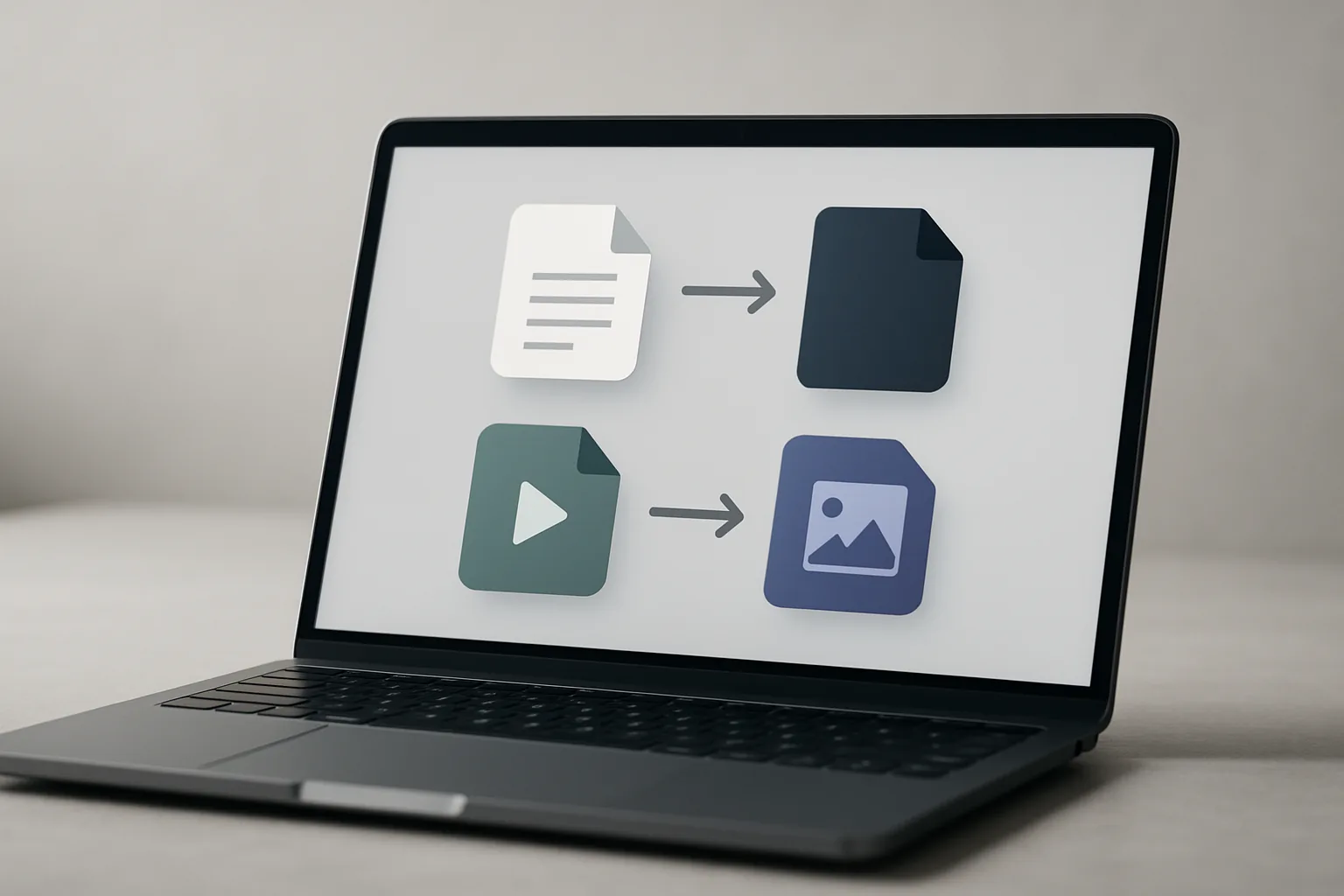
Need to convert a document, image or video to another format right in the browser? We've gathered proven services — no install and no registration.
 Security
A complete guide: how to scan downloads for viruses, encrypt data, transfer files safely and make backups. Practice and proven tools.
A file's format is defined by its extension — it hints which program to open it with. Most tasks are solved by five free tools: VLC, 7-Zip, LibreOffice, VS Code and system viewers. If a file won't open — check whether it is corrupted and whether its extension is correct. Choose your category above and move on to the step-by-step guide for a specific format.
See the full catalog of proven free programs and online services for working with files.
Tools catalog